

|
Getting your Trinity Audio player ready...
|
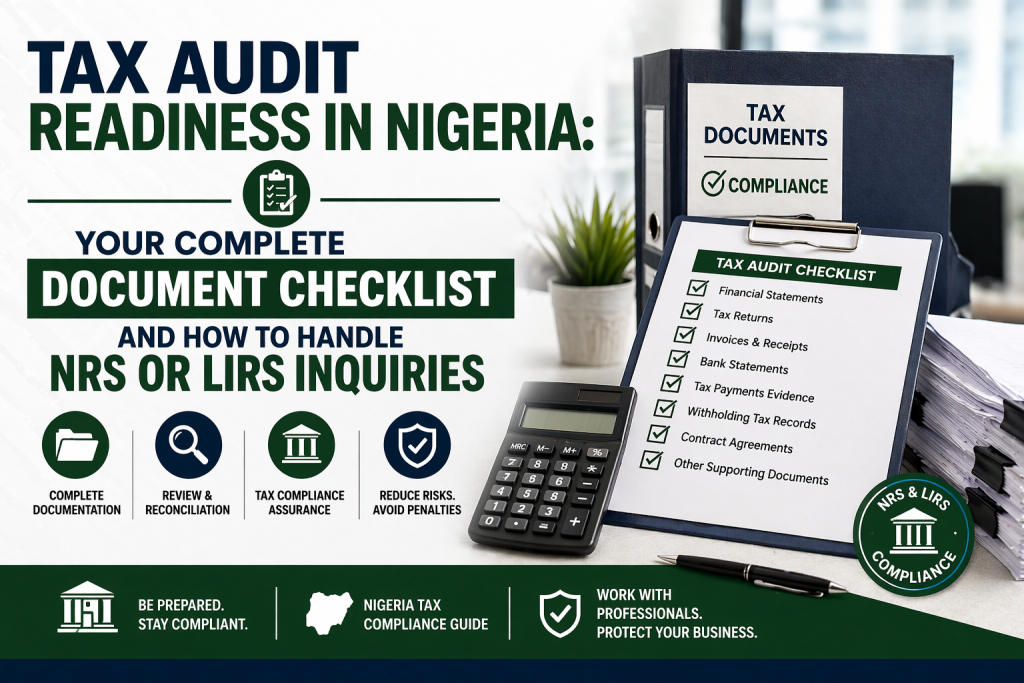
Tax audit readiness in Nigeria is really about being so organised that Nigeria Revenue Service (NRS) or State IRS (like LIRS) never catches you unprepared, even if they show up tomorrow morning at your door step. In this article, we will walk through what that looks like in practice, from the complete document checklist to how to respond to queries without panicking.
1. Understand what a tax audit really is
A tax audit is simply the NRS or a State IRS (like LIRS) checking whether what you have declared and paid matches your true transactions and tax obligations under Nigerian law.
Common types you’ll see:
- Desk review: Done from the tax office based on returns and information on their systems.
- Field audit: Officials visit your office to review your books and documents on-site.
- Investigation: Usually when they suspect serious under‑declaration, fraud, or long‑term non‑compliance.
If you treat a tax audit like a one‑off battle, you’ll always feel attacked. Treat it like part of normal compliance, and you organise your business differently.
2. The core mindset for audit readiness
Before documents, the right mindset makes a huge difference.
- Assume you can be audited at any time, not “someday”.
- Keep things simple and consistent: what is in your financials must match your tax returns, bank statements and schedules. If those four are aligned, most audits go smoothly.
- Don’t lie, don’t guess, and don’t argue emotionally. If you don’t know, say you’ll revert, then respond in writing with evidence.
A helpful way to think about it; if a stranger picked up your files today, could they clearly see what you earned, what you spent, and how you computed your tax?
3. The complete tax audit document checklist (Nigeria‑focused)
Below is a practical checklist you can use as a working template. You will not need every single item for every audit, but if you can tick off 80–90% of this list, you’re in strong shape.
3.1 Corporate and tax identity documents
These are usually the first things requested to confirm who you are and your registration status.
- CAC Certificate of Incorporation / Business Name
- Status report or CAC forms showing current directors and shareholders (for companies)
- Memorandum and Articles of Association or LLP/partnership agreements, where applicable
- Taxpayer Identification Number (TIN) confirmation
- NRS registration evidence (CIT, VAT, WHT)
- LIRS/other state IRS registration evidence (PAYE, State tax)
3.2 Tax clearance and past returns
Auditors want to see what you have declared and whether you’re up to date.
- Tax Clearance Certificates (TCC) for the relevant years (FIRS and State)
- Filed Company Income Tax (CIT) returns (computation, schedules, accounts) for at least the last 3–6 years
- Value Added Tax (VAT) monthly returns and payment receipts
- Withholding Tax (WHT) returns and credit notes
- PAYE returns to LIRS (or relevant state) and evidence of remittances
3.3 Financial statements and accounting records
If your accounting is messy, your audit experience will be messy. This is the heart of the file.
- Audited financial statements
- Trial balance for each year
- General ledger and subsidiary ledgers (e.g. receivables, payables, payroll)
- Fixed asset register (showing cost, additions, disposals, depreciation)
- Bank statements for all accounts for the relevant years
- Bank reconciliation statements
3.4 Revenue and sales documentation
This is where FIRS and LIRS focus heavily because it directly affects your taxable income and VAT.
- Detailed revenue schedules (monthly/annual) tied to the trial balance
- Customer invoices and receipts (numbered and dated)
- Contracts, LPOs, and engagement letters with clients
- Evidence of cash receipts and POS/transfer confirmations
- VAT output schedules (showing VAT collected per invoice)
The key is that the total sales in your financial statements must match your VAT schedules, WHT records, and bank lodgements, barring clearly explained differences.
3.5 Expense, procurement and suppliers’ documentation
Tax authorities want to verify that your expenses are genuine, business‑related, and correctly treated for tax.
- Detailed expense schedules by nature (rent, salaries, fuel, professional fees, etc.)
- Supplier invoices and receipts
- Payment vouchers and approvals
- Contracts/agreements with vendors and consultants
- Evidence of payment (bank transfers, cheques, etc.)
- WHT deducted on vendor payments and proof of remittance
Watch out for:
- Excessive “miscellaneous” or “sundry” expenses without backing
- Large cash withdrawals without proper supporting documentation
- Director or shareholder personal expenses run through the company
3.6 Payroll, PAYE and HR records
NRS, pays close attention to payroll.
- Staff list for each year (name, role, start/end dates)
- Employment contracts and HR policies
- Monthly payroll schedules (gross pay, allowances, deductions, PAYE, pension)
- Payslips and signed payroll summaries
- PAYE computation workings and annual returns
- Proof of PAYE remittances for each month
- Pension schedules and evidence of remittance
- NSITF, ITF and other statutory HR-related payments, where applicable
3.7 VAT and WHT records
These two areas that generates frequent queries and assessments.
- VAT output schedules (sales) and VAT input schedules (purchases)
- VAT returns filed and payment receipts
- WHT schedules:
- WHT deducted from vendors and remitted
- WHT suffered from your customers (with credit notes/receipts)
- Reconciliation of WHT credit notes to income tax computation
The “golden rule”: VAT, WHT, and your ledgers must agree, or you should be able to explain every variance clearly.
3.8 Fixed assets and capital allowances
Auditors want to ensure your capital allowance claims are not inflated.
- Fixed asset register with asset description, location, cost, dates, and depreciation
- Invoices and receipts for asset purchases
- Evidence of disposal (board approvals, sale agreements, proceeds)
- Capital allowance computations and schedules used in your CIT returns
3.9 Related party, loans, and equity
Cross‑border and related party transactions are more sensitive now.
- Intercompany loan agreements, shareholder loan terms, and board approvals
- Transfer pricing documentation (for medium/large businesses with related party dealings)
- Interest computation schedules and evidence of payment
- Dividend payment schedules, withholding tax remittances, and board resolutions
3.10 Other compliance documents
Depending on your industry, these might be requested:
- Regulatory licenses (e.g. CBN, NCC, SEC, NAFDAC)
- Major contracts with government or large corporates
- Evidence of any tax incentives or exemptions granted (pioneer status, free trade zones, etc.)
If you compile these into a structured “audit file” per year (even in soft copy, properly labelled), you’re already ahead of most organizations.
4. How to get ready before an audit comes
Think of this as your internal “pre‑audit”.
4.1 Build an internal tax file every year
Instead of waiting for a letter, build your tax file as you go.
- At year‑end, file: audited accounts, tax computations, capital allowance schedules, and all tax returns and payment receipts for that year.
- Maintain separate folders for VAT, WHT, PAYE, CIT, and other taxes.
- Make sure all schedules tie back to the trial balance and bank statements.
4.2 Do a periodic self‑audit
At least once a year (preferably before filing CIT returns):
- Reconcile revenue per financial statements with VAT and WHT schedules.
- Reconcile payroll records with PAYE and pension submissions.
- Recompute your tax using the Finance Act/Finance Act amendments applicable for that year to make sure your consultant or accountant hasn’t missed anything.
Many assessment disputes come from simple things like unremitted WHT or PAYE, or unreconciled differences the company never cleaned up.
4.3 Create an audit response team
Auditors get nervous when nobody seems to own anything in an organisation.
Minimum team:
- A tax lead (could be CFO, finance manager, or external adviser)
- A documentation officer (who can locate documents quickly)
- A legal / company secretary support (for approvals, powers, and appeals)
Agree internally that staff should not respond to auditors on their own; everything goes through the contact person.
5. How to respond to FIRS / LIRS inquiries and queries
Now to what most people really worry about: that letter or email from NRS or LIRS.
5.1 When you receive a tax inquiry or audit notification
Common documents include a notice of audit, request for information, or a tax assessment (additional liability). Your first reaction must be disciplined, not emotional.
Steps:
- Acknowledge receipt promptly in writing, politely.
- Read the letter line by line:
- What period is under review?
- Which tax type(s) are in issue?
- What documents are they asking for?
- Inform your internal audit team and your tax adviser immediately and schedule a quick strategy meeting.
Many problems arise because taxpayers ignore letters or respond late; penalties and interest then build up.
5.2 General principles for written responses
Every response to FIRS or LIRS should follow some basic rules.
- Use a clear subject that references their letter and date.
- Respond to each point raised, in order, using numbered paragraphs.
- Attach evidence for each point (schedules, copies of receipts, contracts, computations).
- Keep your tone respectful and factual, even if you strongly disagree.
- Avoid speculative statements; if you do not have a document, say so and give a realistic date when you will submit it.
5.3 Responding to a simple information request
For a basic request (e.g. “provide VAT returns for 2022”), keep it straightforward.
- Attach the exact documents requested, nothing more, nothing less.
- Make sure what you send matches what was filed (no differences in figures, dates, or amounts).
- If there are corrections, highlight them, explain the reason, and attach revised schedules.
Providing more information than requested can open unnecessary lines of inquiry; providing less can suggest you’re hiding something.
5.4 Responding to a tax query or proposed adjustment
Here, NRS/LIRS believes you owe more than you declared. They may issue a query or an assessment showing additional tax, penalties, and interest.
Your approach should be:
Understand their basis
-
- Is it a disallowed expense?
- A difference in turnover?
- Unremitted VAT, WHT, or PAYE?
Gather evidence
-
- If they disallowed an expense, show why it is wholly, exclusively, reasonably and necessarily incurred for the business, with contracts and invoices.
- If they say your revenue is understated, reconcile their figure with your books and bank statements and explain any timing or classification issues.
Decide your position
-
- Some items may be clearly wrong on your side: be pragmatic, accept, and negotiate penalties.
- For items where you are correct under the law, prepare a robust explanation with reference to legislation, circulars, or decided cases where possible.
File an objection (if necessary)
-
- Under Nigerian law, you typically have a defined period of 30 days to object to an assessment in writing, stating your grounds clearly and attaching documents.
- If you miss this window, the assessment can become final and conclusive.
5.5 Meeting with NRS / LIRS officers
Most audits involve meetings. Use them wisely.
- Go in prepared: know your numbers, major contracts, and any major changes in those years.
- Stick to facts; avoid volunteering stories or information not requested.
- If you’re unsure of an answer in the meeting, say you will cross‑check and revert, then follow up in writing.
Having a tax adviser with you helps keep the discussion within the right boundaries.
5.6 If you still disagree – escalation options
If, after your objection, you still disagree with the position of the tax authority, you’re not helpless.
Options commonly include:
- Further engagement or reconciliation meetings with the tax audit team.
- Escalation to higher officers within FIRS/LIRS.
- Appeal to the Tax Appeal Tribunal (TAT), and from there, potentially to higher courts on points of law.
Litigation should usually be a last resort; many matters can be resolved through negotiation when you have strong facts and clean documentation.
6. Practical tips to reduce audits and queries
You can’t always avoid an audit, but you can reduce how painful they are.
- File all returns on time and keep a calendar of deadlines; late filing is an easy red flag.
- Make sure your VAT, WHT, PAYE and CIT schedules always reconcile with your ledgers and bank statements; misalignment is a common trigger for queries.
- Avoid “cash culture” as much as possible; transfers with clear narration are easier to defend.
- Maintain a written tax policy for the business: who approves what, how documents are kept, and how returns are signed off.
- Train your finance and admin staff periodically on basic tax rules so they don’t create problems inadvertently (e.g. mis‑labelling personal expenses as company costs).
Final Thoughts
Tax audits aren’t personal, they’re simply part of Nigeria’s drive to improve tax compliance and grow public revenue. The real difference between a messy audit and a smooth one is usually preparation, not luck. When you build audit readiness into your normal way of doing business, good records, timely filings and clear documentation. you remove the fear factor and stay in control.
If you’re in Lagos or dealing with NRS anywhere in Nigeria and you’re feeling overwhelmed, you don’t have to face it alone. Speak with a competent tax adviser early before issues escalate. We can review your current setup, run a mock audit, clean up your documentation and even stand in for you during engagements with NRS or LIRS so you’re not saying the wrong things under pressure.
The bottom line is simple, preparation today will always cost less than a poorly handled audit tomorrow. Stay compliant, stay proactive and keep your business positioned for growth instead of distractions. And if you have specific questions about your own situation or want a second pair of eyes on your tax exposure, feel free to reach out, we’re always happy to help you think it through.